
Xbox Series X: Powering the Next Generation of Gaming
- Unveiling the Power of Xbox Series X
- Xbox Series X Specs and Design: A Closer Look
- The Xbox Velocity Architecture and Quick Resume
- Expanding Your Horizons: Storage Options for Xbox Series X
- Xbox Game Pass: Unlocking a World of Games
- Must-Play Games on Xbox Series X
- Xbox Series X vs. PS5: A Quick Comparison
- Is the Xbox Series X Right For You?
The Xbox Series X is among the most powerful gaming consoles available today, ushering in a new era of gaming with incredible speed and graphical fidelity. As someone who’s spent countless hours with various consoles over the years, I can honestly say the leap forward with this generation is significant. The Xbox Series X, often referred to as a “next-gen console,” has redefined what we expect from home gaming.
When the Xbox Series X launched on November 10, 2020, alongside the Xbox Series S, it marked Microsoft’s entry into the ninth generation of video game consoles. It was clear from the outset that Microsoft was focusing on raw power, speed, and compatibility, aiming to create a console that serves as a playground for technical innovation.
Let’s talk specs, because that’s where the real magic happens. The Xbox Series X boasts a custom 7nm AMD Zen 2 CPU with eight cores, running at 3.8 GHz (or 3.66 GHz with SMT). This is a substantial upgrade, offering about four times the processing power of the Xbox One X. Paired with this is a custom AMD RDNA 2-based GPU, featuring 52 enabled compute units running at 1.825 GHz, capable of a staggering 12.155 teraflops of computational power.
What does all that jargon mean for you, the player? It translates to native 4K resolution gaming at 60 frames per second (FPS), with support for up to 120 FPS and even 8K resolution output. Games look incredibly sharp and run smoothly, making for a much more immersive experience. Ray tracing, a technology that simulates how light bounces in real-world environments, is also supported, adding another layer of visual realism.
The console comes with 16 GB of GDDR6 RAM, split between faster memory for graphics and slightly slower memory for other system functions. A key component is the 1TB custom NVMe SSD, which is pivotal for the console’s speed.
Design-wise, the Xbox Series X has a rather understated, minimalistic black box form factor, measuring 15.1cm x 15.1cm x 30.1cm and weighing 4.45 kg. It’s designed to stand vertically but can also be placed on its side. The front is simple, with the power button and a 4K UHD Blu-ray drive. The top features a large fan for cooling, and thankfully, it’s remarkably quiet during operation, similar to the Xbox One X. Around the back, you’ll find an HDMI 2.1 port, a storage expansion slot, three USB 3.2 ports, and an Ethernet port.
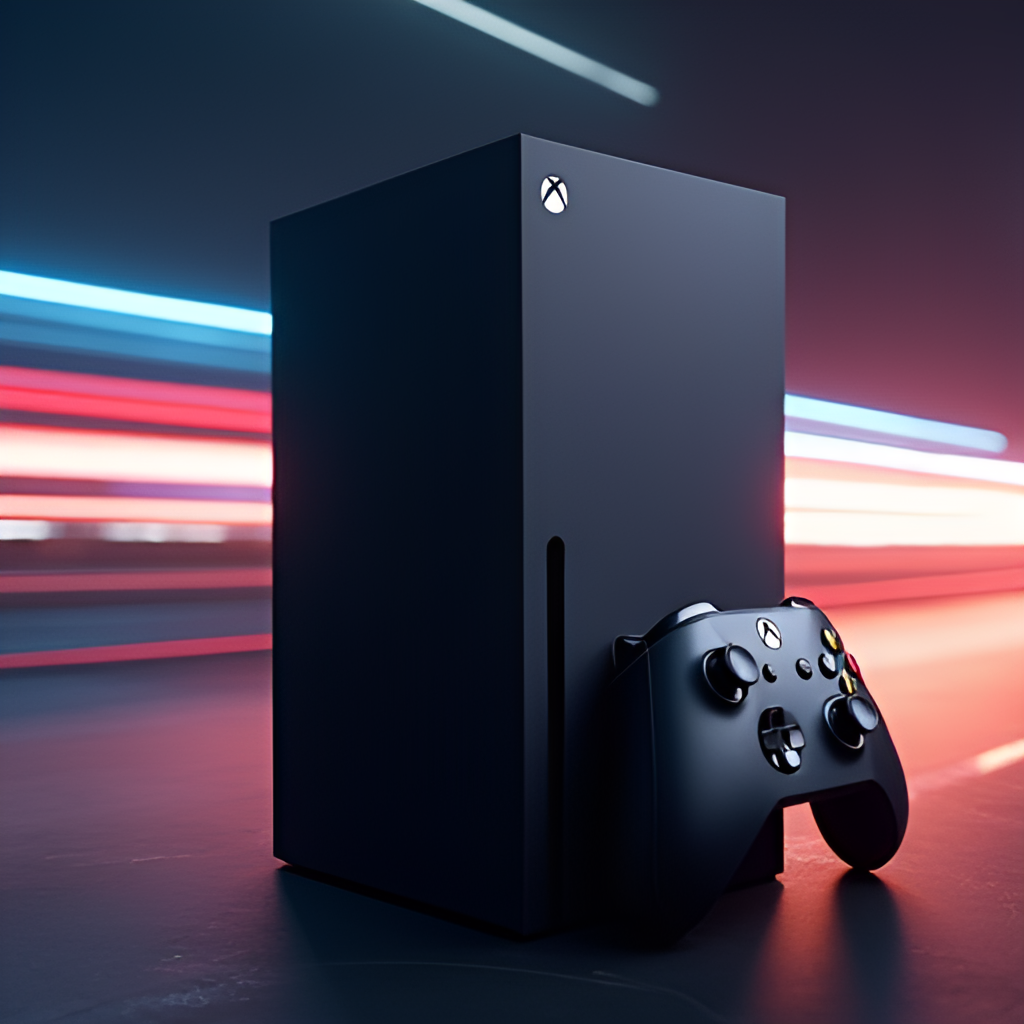
This image is a fictional image generated by GlobalTrendHub.
Beyond the raw hardware, the Xbox Series X introduces the Xbox Velocity Architecture. This isn’t just about having a fast SSD; it’s a combination of hardware and software designed to drastically reduce loading times and allow developers to access game assets almost instantaneously. Microsoft calls it the “soul” of the console. This architecture is what powers some of the Series X’s most impressive features, like Quick Resume.
Quick Resume is a game-changer, literally. It allows you to suspend multiple games simultaneously and jump back into them almost instantly, right where you left off, without going through loading screens or menus. It works by saving the state of the current game to the SSD. I remember being skeptical about how well this would actually work, but in my experience, it’s incredibly seamless. You can typically suspend up to three Xbox Series X/S games at a time, and even more backward-compatible titles.
With game sizes increasing, the 1TB internal SSD can fill up quickly. My personal library, especially with a few AAA titles like Starfield (around 140GB) and Halo: The Master Chief Collection (around 135GB), made me realize the need for more space pretty fast. Thankfully, expanding storage on the Xbox Series X is designed to be straightforward.
The most seamless way to add storage that matches the internal SSD’s speed is by using an official Storage Expansion Card. These are currently made by Seagate and Western Digital and plug directly into a dedicated slot on the back of the console. This allows you to play Xbox Series X/S optimized games directly from the expansion card, just as you would from the internal drive.
You can also use external USB 3.1 hard drives. While these are great for storing your games, you can only play backward-compatible Xbox One, Xbox 360, or original Xbox games directly from them. For Series X/S optimized games, you’ll need to transfer them back to the internal SSD or an expansion card to play. The console is compatible with external drives up to 20TB and above after a software update.
One of the biggest selling points for the Xbox ecosystem, and particularly the Xbox Series X, is Xbox Game Pass. This subscription service offers access to a vast library of games for a monthly fee. The value proposition here is incredible. Some estimates suggest that Game Pass can offer access to thousands of dollars worth of games annually. While you might not play every game offered, the sheer volume and variety are impressive. It’s a fantastic way to discover new titles you might not have otherwise tried.
There are different tiers, including Game Pass Core, PC Game Pass, Game Pass Standard, and Game Pass Ultimate. Game Pass Ultimate, the most comprehensive plan, includes access to both console and PC game libraries, online multiplayer, EA Play, and cloud gaming. A major perk of Game Pass Ultimate is getting access to new first-party Xbox titles the same day they release.

This image is a fictional image generated by GlobalTrendHub.
So, what can you actually play on this powerful machine? The library of games for the Xbox Series X is constantly growing, from titles optimized specifically for the new hardware to a massive catalog of backward-compatible games. Some standout titles that showcase the Series X’s capabilities include Forza Horizon 5, praised for its stunning visuals and open world. Cyberpunk 2077, after receiving updates, also runs beautifully on the console. Other highly-rated games include Elden Ring, Hades, Hitman 3, and the recently released Senua’s Saga: Hellblade 2, which pushes visual boundaries.
Thanks to backward compatibility, you can play games from every Xbox generation, including the full Xbox One library and select Xbox 360 and original Xbox titles. Many older games even see performance improvements on the Series X through features like FPS Boost and Auto HDR.
It’s impossible to talk about the Xbox Series X without mentioning its main competitor, the PlayStation 5 (PS5). On paper, the specs are quite similar, with the Xbox Series X technically having slightly more raw power (12 teraflops vs. PS5’s 10.3). However, in practice, the performance and graphical fidelity are often very similar between the two consoles.
The design of the two consoles is quite different, with the PS5 being larger and more visually striking compared to the Xbox Series X’s more subtle box shape. Where they really differ is in their approach and exclusive games. PlayStation tends to focus more on high-profile first-party exclusives, while Microsoft is heavily invested in the value of Xbox Game Pass and building a broader gaming ecosystem.
The PS5’s DualSense controller with its haptic feedback and adaptive triggers is often cited as a standout feature, offering a different level of immersion compared to the more traditional, albeit refined, Xbox Wireless Controller (which still uses AA batteries, a minor annoyance for me!). Both consoles offer fast loading thanks to their SSDs and support features like variable refresh rate (VRR) and auto low latency mode (ALLM).
In conclusion, the Xbox Series X is a formidable piece of hardware that delivers on its promise of next-generation gaming. Its power, speed enhanced by the Xbox Velocity Architecture, and features like Quick Resume make for a smooth and enjoyable gaming experience. The extensive backward compatibility and the incredible value offered by Xbox Game Pass further strengthen its appeal. The Xbox Series X is a compelling choice for anyone looking for a powerful console with a vast and accessible library of games.